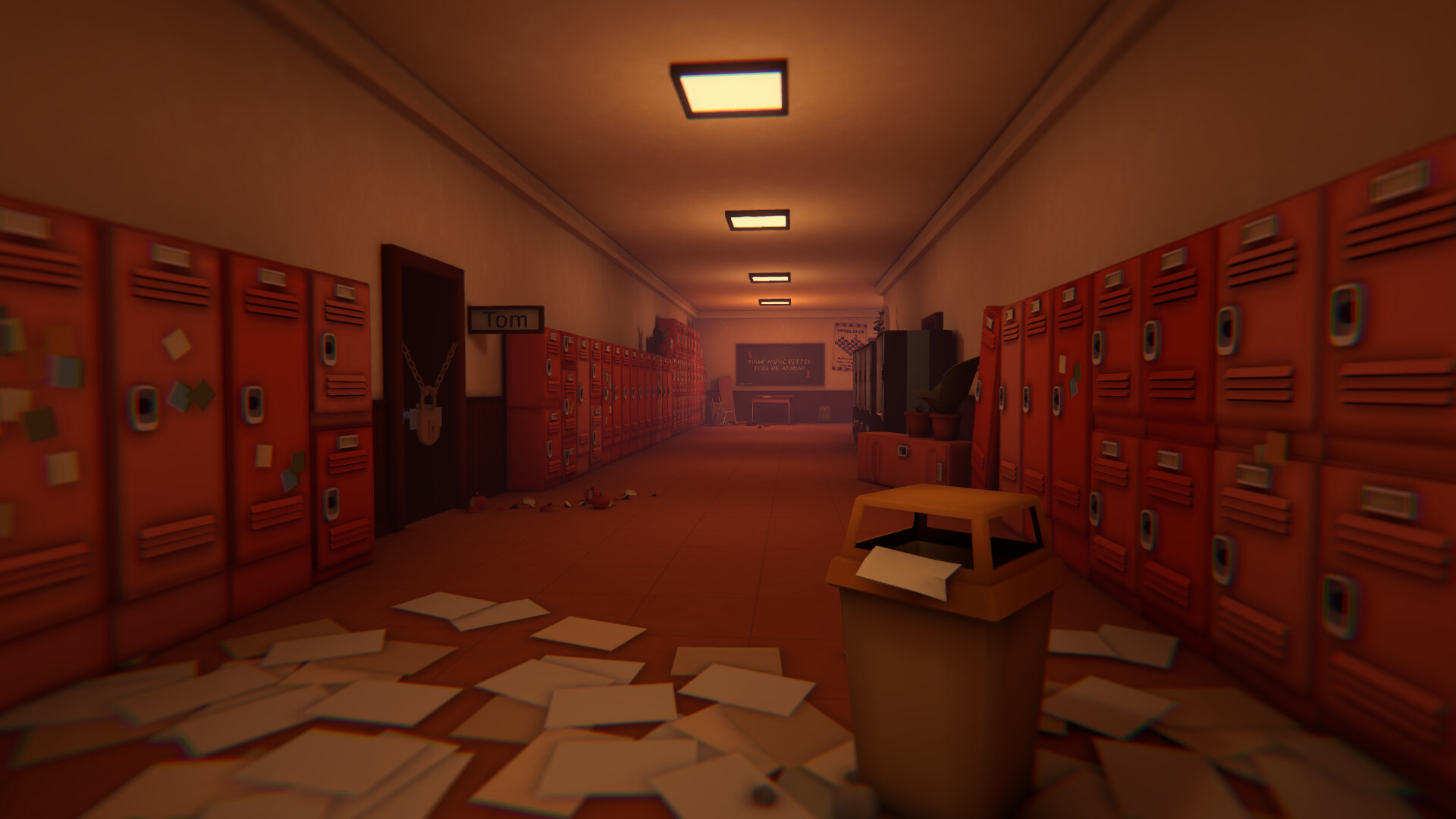
Time To Wake Up follows Alan Malone as he explores his dreams, manifested as abstract hallways, libraries, and classrooms. His memories of his youth captured in his childhood drawings, hanging from the walls of his subconscious like an art gallery in slumber.
Each time Alan blinks, which he thankfully only does on command, his surroundings change entirely. This mechanic allows you, as Alan, to navigate through a myriad of platform and basic navigational puzzles, all in a quest to find some closure.
The game shows absolutely outstanding visual storytelling, perfectly capturing the sense of being in a dream, while making it intriguing and understandable to interpret the events of Alan’s past that still follow him mentally. It’s clear that Alan had a difficult childhood, one in which he struggled to express himself or feel understood by those around him. He personifies those around him in his childhood drawings, and subconscious, not by their defining features, but by their stares.
However, at some point in his childhood, Alan becomes fixated by the fictional book, Hell Is Other People, by fictional author Tom Fiddleton. In a euphoric experience that might be all too relatable for many neurodivergent players, Alan finds that Fiddleton’s work perfectly encapsulates his feelings on the world, finally allowing him to feel seen. Alan uses quotes from Fiddleton’s book as tokens of his friendship, choosing to express himself through snippets of the authors work where he cannot find his own words.
You explore the friction he had to endure as his parents, teachers, and friends, all became resistant to Alan’s fixation, finding his obsession with the book all-consuming and potentially parasocial.
Along your journey you are joined by a disembodied voice, for want of a better description. It’s clear that this is somehow partly Alan, but not completely. It talks about us and we at times, but about you at others. It reassures, guides, and berates you equally. As you write down an account of your experience in your journal, you are given the option whether or not to trust this disembodied voice with your written observations.
It’s clear that there’s going to be much more to this when the full game is released, currently unannounced, but expected to be this year. You can certainly consider me hooked to learn more about the significance of this voice, whether it can be trusted, and whether Alan can finally make peace with his troubled dreams.
This is one of the first demos I’ve played in a while that so perfectly demonstrates how spoiled we’re getting for lengthy immersive atmospheric experiences. Only a decade ago, this demo experience alone would’ve been enough to turn heads and take payment. We’ve certainly seen only marginally longer games than this 40 minute playthrough garner cult followings and become core memories for a generation of gamers.
The developers of Time To Wake Up, Eye Blink Twice, have teased some features expected in the full release that don’t feature so far in the game’s demo version. Including these staring eyes that have for now only been shown as creepy observers, potentially becoming adversaries that must be avoided.
This is Eye Blink Twice’s debut title, and one that’s likely to catapult them into the good graces of atmospheric narrative walking simulator fans, if the demo is anything to go by. Make sure to head over to their steam page to wishlist the game if you’re interested in seeing how it progresses towards release, and I highly recommend playing the demo for a fully immersive experience that I could never do justice in this review.
Leave a Reply