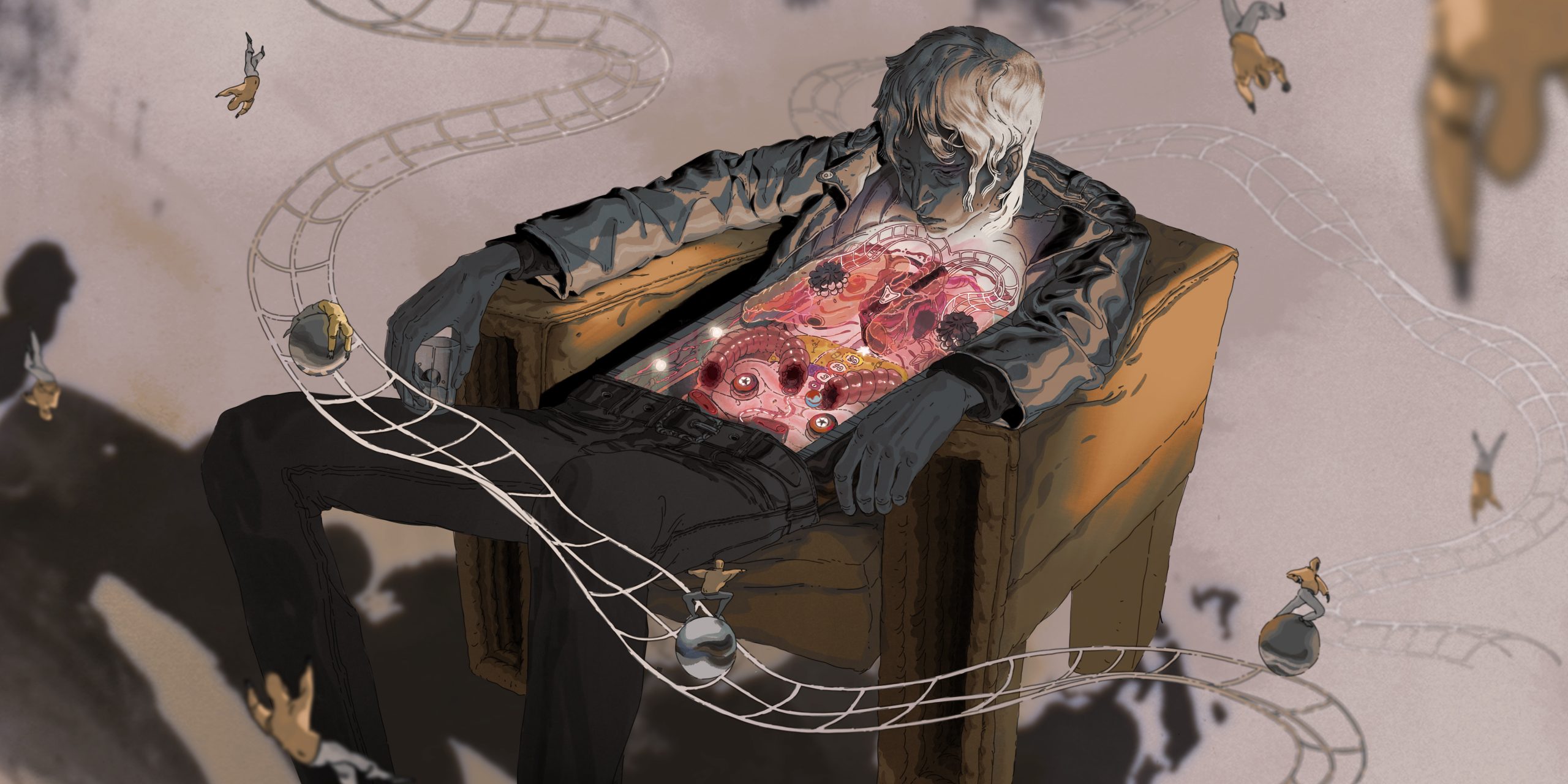
ZA/UM’s latest game, a statement already not without controversy, ZERO PARADES: For Dead Spies, released late last month to generally favourable reception. What struck me however, was something regrettably far from unusual with games in this genre. A lot, and I really mean a lot, of reviews posted by people with nowhere near enough time in game to have experienced even the most straightforward version of the main plot, let alone the game’s fairly extensive side-content.
Now don’t get me wrong, I understand why this is. The gap between review keys being distributed and the games release to the wider public is getting shorter and shorter by the year, and publications rely heavily on getting their reviews out in time for the launch day buzz. This game however, suffers more than most.
There are lots of genres where a mid-playthrough review is kind of understandable and excusable: open world RPGs, multiplayer games without any traditional ending, MMOs with endgames designed to be accessible only to folks with thousands of hours of play time, 4X, grand strategy, or real-time strategy games where the endgame really only exists through permutations of the same mechanics… The list goes on.
I do personally subscribe to the idea that you should finish a game before reviewing it when that game has a straightforward and widely agreed “ending”, but some people take this to real extremes. Just take a look at Mortismal Gaming’s 100% playthroughs, probably the only way of reviewing with undeniably total experience of everything the game has to offer.
ZERO PARADES is, at its core, a spy thriller. The entire point of this games plot is to follow the three act structure that you see commonly in this genre, and a few similar genres too. If you’ve ever watched a police procedural, detective show, medical drama, even some sci-fi… You’ve probably come across this structure before. It goes like this: setup, confrontation, resolution.
There’s some wiggle room of course, and its the details within and around these acts that actually give a game, novel, tv show, or movie, its sauce, its unique appeal. But nevertheless, the idea of getting from setup to confrontation, and then reviewing the game without seeing its resolution, is crazy to me. So here I am 53 hours of playtime later, to throw my hat in the ring.
First of all, I’m well aware that there’s a small but vocal community of people who essentially want to boycott this game due to the ongoing drama around ZA/UM’s corporate structure, and the ousting of key players in the company that were central to the development of their poster child: Disco Elysium.
So please keep the following in mind: ZA/UM, from what we know, didn’t even start working on this game until after the corporate restructuring took place. The story is not a sequel to Disco Elysium, nor is it set in the same universe. It is a completely different game, that just also happens to be a story rich RPG. Suzerain, Esoteric Ebb, and Citizen Sleeper are games that should show you this formula and design language is far from unique to ZA/UM, or Robert Kurvitz.
ZERO PARADES, like many cRPG’s, starts off with character creation. The skills at play are mostly self explanatory, bar a few slightly less straightforward options. “Doppelgang” comes to mind, which consists of equal part self-awareness, inner strength, and at times like the angel and devil on your respective shoulders. The good news is that you get more skill points throughout the game than you can shake a stick at, so this initial character creation has rather little impact.
Skills are also easily and quickly modified though clothing choices, of which there are 9 possible slots and dozens of easily accessed options that you will find around Quisach. The UI is not only intuitive, but also beautiful, and incredibly well fitting to the espionage thriller vibes.
These skills are used in a variety of foreground and background checks, determining which information you have access to, and at what pace you progress through different areas of the game. They are split into three key sections, the faculty of action, relation, and intellect. Each are associated with a status or “health” bar of sorts. Fatigue, anxiety, and delirium.
This system is one of the most captivating parts of the game to me. Unlike its predecessor, Disco Elysium, ZERO PARADES’ plot doesn’t progress by the day, but instead by key plot points. When you actually encounter those events will depend on how you choose to manage those health bars. Failed skill checks, as well as generally tiring, anxious, or delirious experiences, will gradually accumulate in your fatigue, anxiety, and delirium bars.
If and when those bars accumulate past the first marker, you gain a de-buff status the gives you disadvantages on checks made against skills in that faculty. If you reach all the way to the top of that status health bar, you have to reduce one of your skills in that faculty from a sub-selection of three chosen at random. So short-term rushing will lead to long-term penalties.
The intention instead, is that you manage these statuses through the use of alcohol, cigarettes, and coffee. Consumables are found extensively throughout the game, honestly, probably too extensively. In the early game it feels as though you are inundated with consumables at a time with comparatively few plot points likely to cause significant impacts on your status. As you move forward through the game, you are likely to earn more money, which you can in turn exchange for consumables as necessary.
Much like Disco Elysium, there are skill checks of the white and red variety. With white indicating repeatable checks, unlocked for another attempt after sleeping or levelling up the relevant skill, and red checks being single attempt only. You can increase your chance of succeeding a check by “exerting”, a new and enjoyable mechanic, sacrificing fatigue, anxiety, or delirium, for a higher chance of success. The interaction between these mechanics leads to a fun balancing act of trying work out where it’s worth this extra risk, and where you can accept failure.
Should you ever find yourself in a position with excess room in your status bars, or the need to pass a few hours of in-game time, there are options around Quisach to work in different side hustles, each impacting a different one of your status bars in return for a bit of Sol, the in-game currency of Portofiro.
Should you run out of consumables, and maybe want to pass even more time, you of course have the option to sleep. I have to point out my admiration for actually making it so that you can sleep any time of day, but require at least 8 hours to go by before sleeping again. Apart from an infinite money glitch since patched out of the game, ZA/UM have done a respectable job at avoiding adverse incentives to break immersion and metagame – think making 1,000 daggers in Skyrim to up your blacksmithing skill.
That is not to say that the game released in a polished state. Game breaking bugs that hampered menu interaction forced a good handful of restarts throughout my playthrough, and for a game pitched as fully voiced, there are remarkably lengthy segments, including very prominent plot points, missing their voiceovers. For a few days post launch, there were even lines with seemingly completely different voiceovers attached to them.
The developers do appear to be doing their best to rectify this, and some improvements have been made since launch day, but it remains a fact that this game is not quite fully voiced. More like, 85% voiced, if I had to guess. This isn’t a particularly big deal for me, most similar narrative RPGs, including Disco Elysium, I have played without any voice over option available, and I’m an avid reader. But if you go into this hoping for a predominantly audio experienced, just keep this in mind.
Music plays a significantly smaller role in ZERO PARADES than other games in this genre. That’s not to disparage the excellent soundtrack by Fernando Cabrera that you’re listening to right now, but the music very intentionally sinks into the background of this game. The intent very clearly and effectively being that it can creep up on you, almost undetected, in times of great stress. The track “Interrogatrix” does this better than any other in my opinion. It’s disjointed unpredictable nature capturing a tense and unexpected sequence as the game transitions to its second act.
Despite its smaller role in the actual playing of the game, it is prominently front and centre in ZERO PARADE’s plot. The cyber-grunge music found all around the world, stored on a variety of fictional formats existing somewhere between real world CD’s and cassette tapes, directly impact the plot from beginning to end. Expect to get intricately involved in debates on the merits of art, formats, and culture, as extensive parts of the game’s hooks.
Speaking of hooks, it’s here where we have to get into what I think are some of the more troubled parts of ZERO PARADES. I would best describe the game as a sequence of extremely satisfying, well written, immersive short stories, and the game functioning as an anthology of those stories. There is a throughline plot, but it lacks the simple underlying motivations that keep a story like this moving.
To take its most closely related predecessor as an example, Disco Elysium begins with your character experiencing amnesia. To say he has little idea what’s going on would be an understatement. I wouldn’t even want to reveal the characters name here since that alone is something that takes most players a dozen hours to find out. Your character in ZERO PARADES, Hershel, cryptonym CASCADE, has no such diegetic reason to need to discover and learn in the opening few hours of the game.
This results in a rather unsatisfying premise. Characters and plot points often lack the intended impact, because alongside their artistic presentation, you receive exposition that reveals extensive character background. You are not shown this as someone learning it for the first time, but more as a refresher summary of something you’ve never been aware of before. In this way, the player is often taught to distrust their gut instincts about the world they’re exploring, as they are just as quickly invalidated by parachuting in something from CASCADE’s past.
By skipping this diegetic learning phase, the game starts in a frustratingly complex position and with very unclear motivations. Within just 30 minutes of play it would be easy to run out of much to care about to spur your investigations forward. To once again compare with Disco Elysium, in that game your motivations are incredibly clear and straightforward, essentially twofold: Solve a murder case, figure out who you actually are along the way.
The second part is of course, kind of an illusion. Unlike in ZERO PARADES, it’s not about literally learning your characters lore, it is about putting brush to the blank canvas of your character through your own action, or inaction, during your time in Revachol. You essentially create your own character arc, most poignantly noticeable in the games “copotypes”.
CASCADE’s past is set in stone, and the way you would traditionally shape and mould a character in an RPG like this isn’t much less disappointing. Dialogue options are extremely limited at times, railroading the player into narrow pre-planned trajectories. Even where choices are more open and free, they frequently fall into the ever-growing “Yes, Sarcastic Yes, No But Yes, Question” quadrilogy that most famously hampered Fallout 4 all the way back in 2015.
Thinking again about the structures of thrillers, one of the best and most consistent ways of producing a satisfying story arc is to start simple, get complex, and then tie things up simple again, but in a way that truly involves and integrates all of the complexities you went through. When you hear people talk about wrapping a story up in a neat bow, this is what they mean.
ZERO PARADES late game does have multiple endings that vary enough to warrant their own reviews potentially. The game does succeed in wrapping up simply, but it’s a messy bow at best. Massive parts of the plot are left unresolved – presumably red herrings in hindsight? But if more than half of your story is comprised of red herrings, then it might be reasonable to call it disjointed, or even describe a lot of it as filler.
There is no doubt that ZA/UM has a captivating world and an interesting story to sell, but its heavy handed delivery makes decision making feel like a quick time event, rather than a sequence of branching opportunities for character growth and story progression. There’s the right thing to do, and the wrong thing to do. One will progress the story, the other will patiently wait for you to come back and change your mind.
We have been spoiled in this genre lately, so it’s important that I try and look at this game through that lens. Ultimately, if you are a fan of the jazzy cyber-grunge art direction, you will find few other games capable of reaching the highs of ZERO PARADES. If you like narrative driven cRPGs, you will find few as ambitious and extensive too. But where concise quality and novel storytelling is concerned, there are better options. For ZERO PARADES, I give a score of 79/100.
Leave a Reply